Furniture assembly · 3 min read
Will a wall-mounted folding table fit when someone pulls up a chair?
A folded table can leave plenty of room for the kitchen door to swing, then block the same door when you open the leaf for breakfast. Before choosing a wall, lay out the table at full depth and pull up the chair you’ll use. The chair back may be the part that decides whether the spot works.
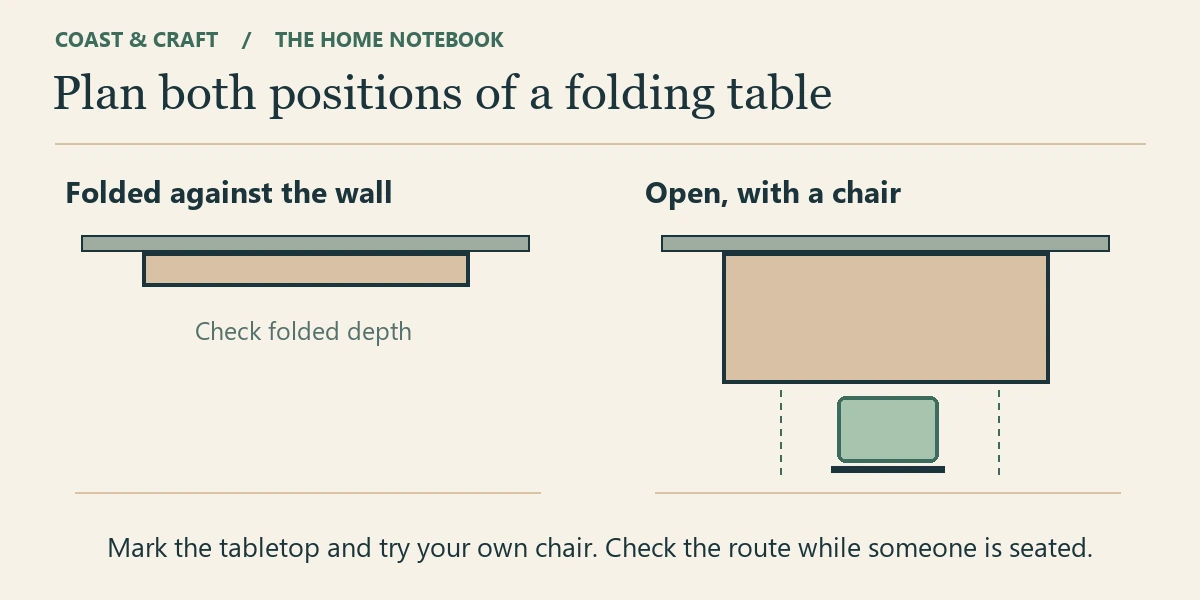
Mark the two front edges on the floor
Use the overall depth in each position from the model drawing. A storage box or fixed shelf can project into the room even with the leaf folded. Mark the full width as well as the depth so you can tell whether a corner crosses a doorway.
For example, Twofold Spaces lists its Space Table at 23.5 inches wide, 7 inches deep folded and 28.6 inches deep open. Suppose there are 60 inches from the mounting wall to a cabinet handle opposite. With this desk folded, 53 inches remain. Opening it leaves 31.4 inches. If the back of your occupied chair extends another 18 inches beyond the work surface, the gap behind you shrinks to 13.4 inches. Try that layout in the room before counting on anyone being able to pass.
Try the chair, the cabinet and the fold
Hold a sheet of cardboard the size of the open top at the height you have in mind. With the chair in place, try opening the pantry door or nearest drawer. Then pull the chair back as far as you do when standing up. In a shared kitchen, have someone walk the usual route with the chair there.
Look at the wall area the leaf covers as it moves. A switch might be easy to reach with the top open and hidden when it folds. Decide where the chair and anything on the tabletop will go afterward. If folding the desk means moving the laptop onto the dining table every afternoon, include a storage spot in the plan.
Find out what supports the outer edge
A bracket-supported desk and a table with a folding leg can occupy the same outline but feel different underneath. JASIWAY’s wall-mounted folding dining table has a leg that reaches the floor. Mark its landing spot as well as the tabletop corners. Check that the leg can seat fully on the floor at the height shown in the drawing, without meeting a chair foot or straddling the edge of a rug.
UPLIFT’s Floating Desk uses wall brackets and sits at a fixed height once mounted. Its product page lists a 500-pound capacity for that desk and specifies wood-stud mounting. UPLIFT advises against mounting it to metal studs or concrete. Have the installer check the proposed wall against the selected model’s requirements. If you plan to keep equipment on the top, include its weight when asking about the load limit.
Choose the height before requesting assembly
Sit at a table that feels comfortable with the intended chair and measure its top from the floor. Compare that height with what the folding model allows, including room for your knees under the brackets or beside a leg. For a project request, include the model link, preferred top height, wall photo and distances to nearby doors or cabinets. Ask who will verify wall support and whether mounting is included in the assembly scope.
Sources & product details
Manufacturer instructions for your exact product take precedence over general planning guidance.